
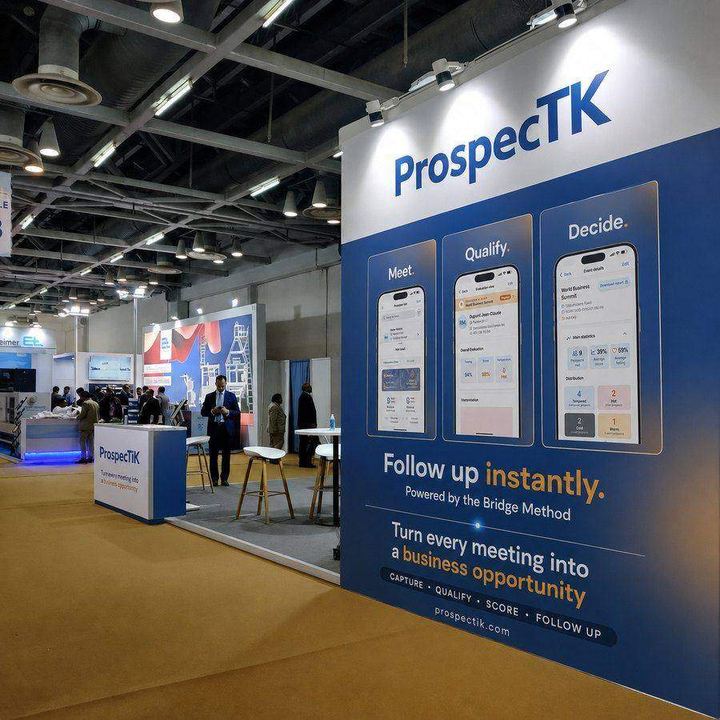
A mid-sized booth at a national trade show costs, all in, several tens of thousands of euros: floor space, fit-out, transport, accommodation, and above all the time of three to five sales reps tied up for a week. What you get in return fits in one sentence: a few hundred conversations. The whole game is knowing what is left of them six weeks later.
At beTIK, we have supported sales teams for years, and the same finding comes up everywhere, whatever the industry: it is almost never the quality of the booth or the pitch that sinks a trade show. It is the loss of information. Excellent conversations, held by competent salespeople, that evaporate between the handshake and the follow-up.
This guide walks through the method in order. It is deliberately concrete: no "polish your brand image", only decisions you can make this week.
1. Decide why you are going, with a number
The question almost no exhibitor can answer on the first morning: how many qualified contacts do we need to bring back for this show to pay off?
The calculation is simple and it changes everything else:
- Add up the full cost of your participation, sales time included.
- Divide by the margin on an average deal, then by your usual conversion rate from qualified contact to customer.
- You get the number of qualified contacts needed to break even.
An example. €30,000 of full cost, an average deal of €12,000 at 35% margin, a 20% conversion rate: you need about 35 qualified contacts to cover the expense, and twice that for the show to be a good investment, meaning 70 genuinely qualified contacts, not three hundred business cards.
This number has an immediate virtue: it changes how the team behaves on the booth. You stop collecting and start sorting. The full calculation is covered in our article on calculating trade show ROI.
Define what a "good" contact is, in writing
A numeric target is useless if every rep has their own definition of a qualified contact. Before the show, agree on four or five criteria, written on a sheet everyone has read: industry, company size, approximate budget, timeline, and the contact's role in the decision.
Quick test: ask three members of your team to describe, separately, the ideal lead for the show. If you get three different answers, you will bring back three incomparable files.
2. Prepare the show, not just the booth
Trade show preparation plays out over six weeks, and the essential part is not logistics. The full countdown is in our six-week pre-show checklist, but keep three points in mind.
Book meetings beforehand. The list of exhibitors and pre-registered visitors is almost always available. Identify your twenty priority targets, write to them three weeks ahead, propose a specific time slot. A show where you arrive with eight meetings already in the calendar is nothing like a show where you wait for foot traffic.
Prepare three opening questions, not a pitch. The natural reflex on a booth is to talk. It is exactly the opposite of what you should do. Three well-chosen open questions give you in two minutes what a ten-minute pitch never will: the visitor's real problem, in their own words.
Decide how you will capture information. This is the most neglected and the most expensive point. Business cards in a pocket? A shared spreadsheet on a laptop? A dedicated app? This decision, made two days before the show in a rush, determines the value of everything you bring back.
3. On the booth: qualify, don't collect
Here is the mechanism that costs exhibitors the most, and it is purely cognitive.
When you talk to a visitor, you pick up an enormous amount of implicit information: their tone when they mention their current supplier, the budget they let slip, the real urgency behind a polite request. None of it is written anywhere. It sits in your working memory, and it has a lifespan of a few dozen minutes, the time it takes for three more visitors to come by.
In the evening, you remember having had "a good conversation with someone from the medical sector". By the following Tuesday, you no longer know which one it was.
The three-minute rule
The discipline that changes everything: never let an interesting visitor walk away without recording the context within three minutes. Not the business card. The context. What they are looking for, why, by when, with what budget, and who decides with them.
Three formats work, in order of increasing effectiveness:
- A note on the back of the card. Better than nothing, but you write five words and lose the rest.
- A paper form or spreadsheet. Complete, but nobody fills it in after 3 p.m. on day two.
- A thirty-second voice memo, dictated as you leave the visitor. The only format fast enough to survive a busy show, and the only one rich enough to preserve the context.
Qualify without turning the conversation into an interrogation
The framework we use at beTIK is called BRIDGE: Business need and problem, potential Revenue, Implementation and feasibility, Decision and organization, Go for Engagement. Five criteria, not twelve, because beyond that you cannot remember them standing in the noise.
The point is not to fire off five questions in a row, but to come out of the conversation with an answer, even a rough one, on each of the five points. The full method, with the questions that work, is detailed in our article on five-criteria qualification.
Assign a temperature immediately
Hot, warm, cold. Assigned in the moment, this rating is surprisingly reliable; assigned three days later, it is worthless. It will determine your follow-up order, and follow-up order is the main conversion lever of a trade show.
4. Afterwards: the 48 hours that decide
Your prospect visited forty booths in two days. The window during which they can still tell you apart from your competitors is short, and it closes fast.
Three principles are enough:
- Follow up in priority order, not in file order. Hot contacts the same evening or the next morning, warm ones within the week, cold ones in a long sequence.
- Quote a specific detail from the conversation. "You mentioned your traceability problem on line 3" gets a reply. "Great to have met you on our booth" gets none.
- Propose a concrete action, with a time slot. Not "feel free to get back to me", but "are you available Tuesday at 2 p.m. or Thursday at 10 a.m.?"
The full sequence is in our article on post-show follow-up.
5. Debrief, and write it down
One week later, gather the team for thirty minutes and record four numbers: number of contacts, of which qualified contacts, number of meetings booked, full cost. Those four numbers, compared year over year, are the only serious basis for deciding whether to return or look elsewhere.
Add two sentences of qualitative notes: what worked, what you will not do again. Twelve months later, nobody will remember unless it is written down.
Where ProspecTIK comes in
We built ProspecTIK for one precise point in this journey, and only one: the gap between the conversation and the follow-up, where the information gets lost.
- On the booth, scanning a card, a badge or a QR code creates the complete lead record. No typing, no pile of cards.
- As you leave the visitor, you dictate thirty seconds. The AI pre-fills the BRIDGE framework, calculates a score and assigns a temperature.
- That evening and over the following days, the app sends follow-ups matched to the level of interest, and generates the event report: breakdown by temperature, named list of priority leads, exportable statistics.
The app does not bring visitors to your booth and does not replace your pitch. It solves the narrower, and far more expensive, problem of lost context.
Haven't settled your calendar yet? Start with the 5 best sites for finding a trade show, then the criteria for choosing where to exhibit.